
Act faster on grid upgrades and expansion with a single source of spatial truth
Pivvot brings parcel, environmental, jurisdictional, and grid information together into one interactive map, so you can evaluate transmission and interconnection route and siting opportunities using a single spatial source of truth instead of juggling disconnected GIS files and spreadsheets.
Pivvot provides spatial analytics across the mainland United States to help GIS professionals, engineers, planners, utilities, energy developers, and AEC organizations answer complex, location‑driven questions related to land, infrastructure, environmental risk, and asset planning.
Generate and compare optimized, constraint-aware routes in minutes, all while incorporating your existing pipeline, electric transmission, or other asset data.
By combining spatial data intelligence with your own project and asset layers, your teams can:
- Move faster on capacity and reliability projects tied to planned multibillion‑dollar transmission upgrades and data‑center‑driven load growth.
- Prioritize substation expansions, new lines, and grid‑hardening work in the locations that are truly buildable and schedule‑feasible.
- Cut weeks out of early planning and permitting by relying on pre‑built, defensible analytics instead of manual data compilation across counties and agencies.
Grid-ready siting for substations, solar & storage using spatial intelligence
Find buildable, grid‑ready sites with Smart Parcels
With Pivvot Siting, you can:
- Use more than 500 refreshed data sets to filter out parcels with hidden wetland, floodplain, environmental justice, wildfire, or geotechnical issues before you commit field time.
- Quickly calculate usable area for new substations, utility‑scale solar, and storage using project‑specific setbacks, no‑build buffers, and terrain constraints—so capacity estimates are based on realistic buildable area using Pivvot’s Site Sketch Tool.
- Export parcel and landowner information to streamline acquisition for substation sites, line re‑routes, and grid‑hardening projects across your service territory.
Pivvot Siting Smart Parcels – example shows parcels 200 acres or greater owned by the same entity
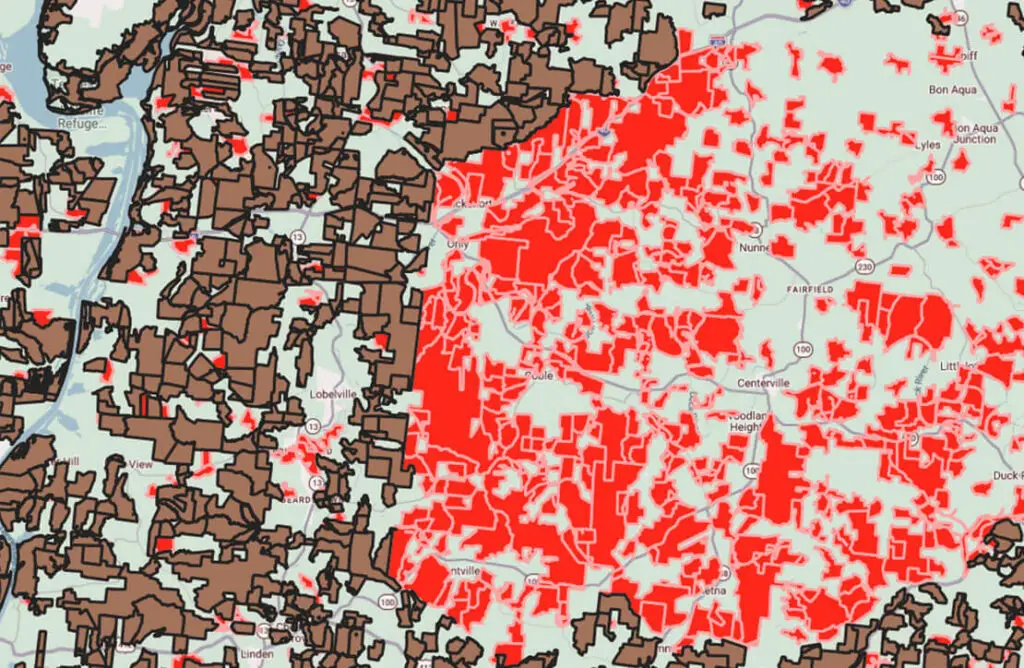
KEY
Brown = Tax map parcels 200 acres or greater
Red = Smart Parcels (merged tax map parcels owned by the same entity that combined are 200 acres or greater)
Green = areas are less than 200 acres


Linear Routes That Keep Your Projects on Schedule
Design least‑cost, minimal‑impact paths and automatically pull crossing and impact reports
With Pivvot Route, you can:
- Generate and compare multiple alternative routes from project areas to the grid in hours instead of weeks, while honoring preferred, avoid, and exclusion zones for wildfire risk, communities, and sensitive lands.
- Colocate with existing transmission to reduce new right‑of‑way and permitting friction on major capacity additions and undergrounding initiatives.
- Summarize every key interaction along a corridor with a Crossing & Impact Report showing railroads, pipelines, roads, wetlands, land‑use changes, segment lengths, and more—giving project teams a defendable view of cost and risk up front.

Data as a solution: Spatial Intelligence Edge
Behind every Smart Parcel, Site Sketch, and Crossing & Impact Report is Pivvot’s Data Engine, which curates and refreshes more than 500 data sets spanning parcels, land use, environmental conditions, geotechnical information, hydrology, energy infrastructure, and more.
- Your teams don’t have to source, clean, and maintain massive geospatial datasets internally; Pivvot keeps them current and accessible through a single platform, freeing staff to focus on planning and execution.
- You can blend internal project and asset data (existing lines, underground segments, substations, and planned upgrades) with Pivvot’s datasets for a unified spatial picture of opportunity, risk, and community impact.
- You can request specific extracts and data packages that plug into your GIS, CAD, or analytics systems, extending the value of Pivvot across your internal wildfire‑hardening, reliability, and growth‑planning workflows.
Pivvot is a wholly owned subsidiary of Terracon